Understanding k-space
What's an MRI Actually Doing?
🧲 Strong magnetic field
🔄 Hydrogen atoms align and spin
📡 RF pulse tips them over
📶 They precess and emit signal
Larmor Precession
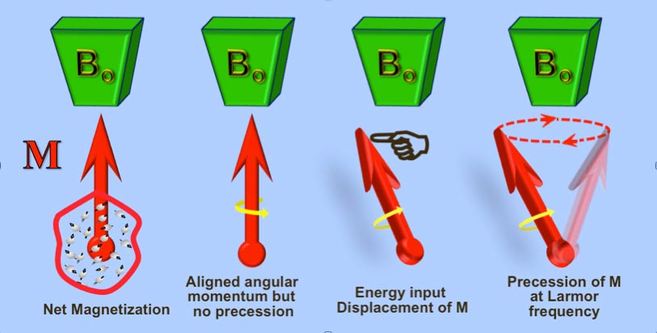
Hydrogen atoms precess around the magnetic field
f = γ × B₀
The Problem
Every hydrogen atom gives the same frequency signal

How do we know WHERE the signal came from?
Enter Gradients
Creating Spatial Information
Gradients Change the Game
Gradients make the magnetic field slightly different at different locations
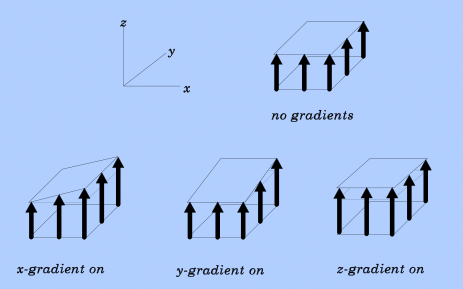
This changes the Larmor frequency based on position!
Now We Have Spatial Encoding
Different positions → Different frequencies → Different accumulated phase
📍 Position information encoded in phase
What is K-Space?
The spatial frequency domain of image data
Image ↔ K-Space Relationship
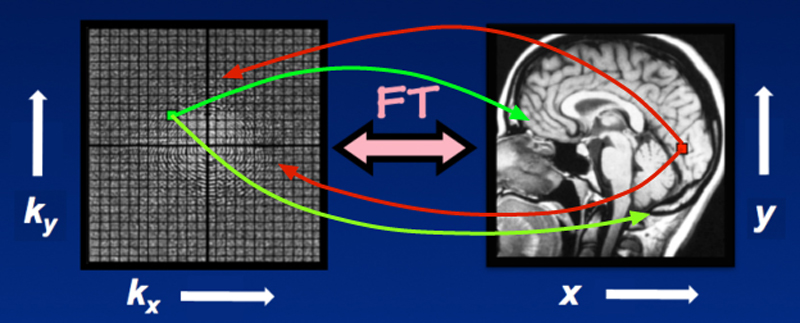
Fourier Transform connects image space and k-space
K-Space Geography
Center: Low spatial frequencies
→ Image contrast, overall brightness
Edges: High spatial frequencies
→ Fine details, sharp edges
How We Navigate K-Space
🎨 The Etch-a-Sketch Analogy
Gradients are like the two knobs on an Etch-a-Sketch
They control exactly where we "draw" our line through k-space
Different "Drawing" Patterns
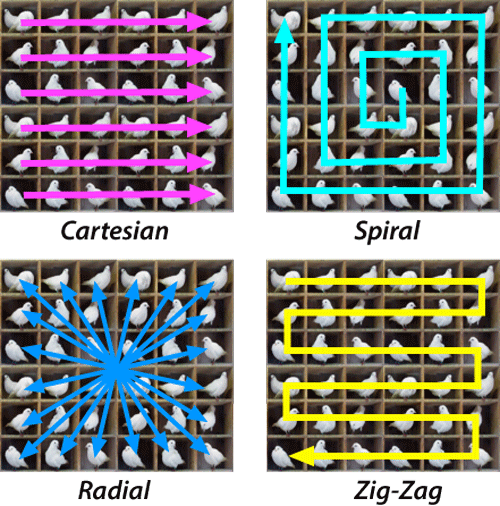
Different k-space sampling trajectories
Etch-a-Sketch in Action
Navigate K-Space with Gradients
Use gradients to control your path through k-space
Key Takeaways
🎯 K-space center = contrast
🔍 K-space periphery = detail
🎛️ Gradients are your "knobs" for navigating k-space